HVLS Fan Motor Types: Gear Drive and PMSM Direct Drive
Last updated: 2026-11-08
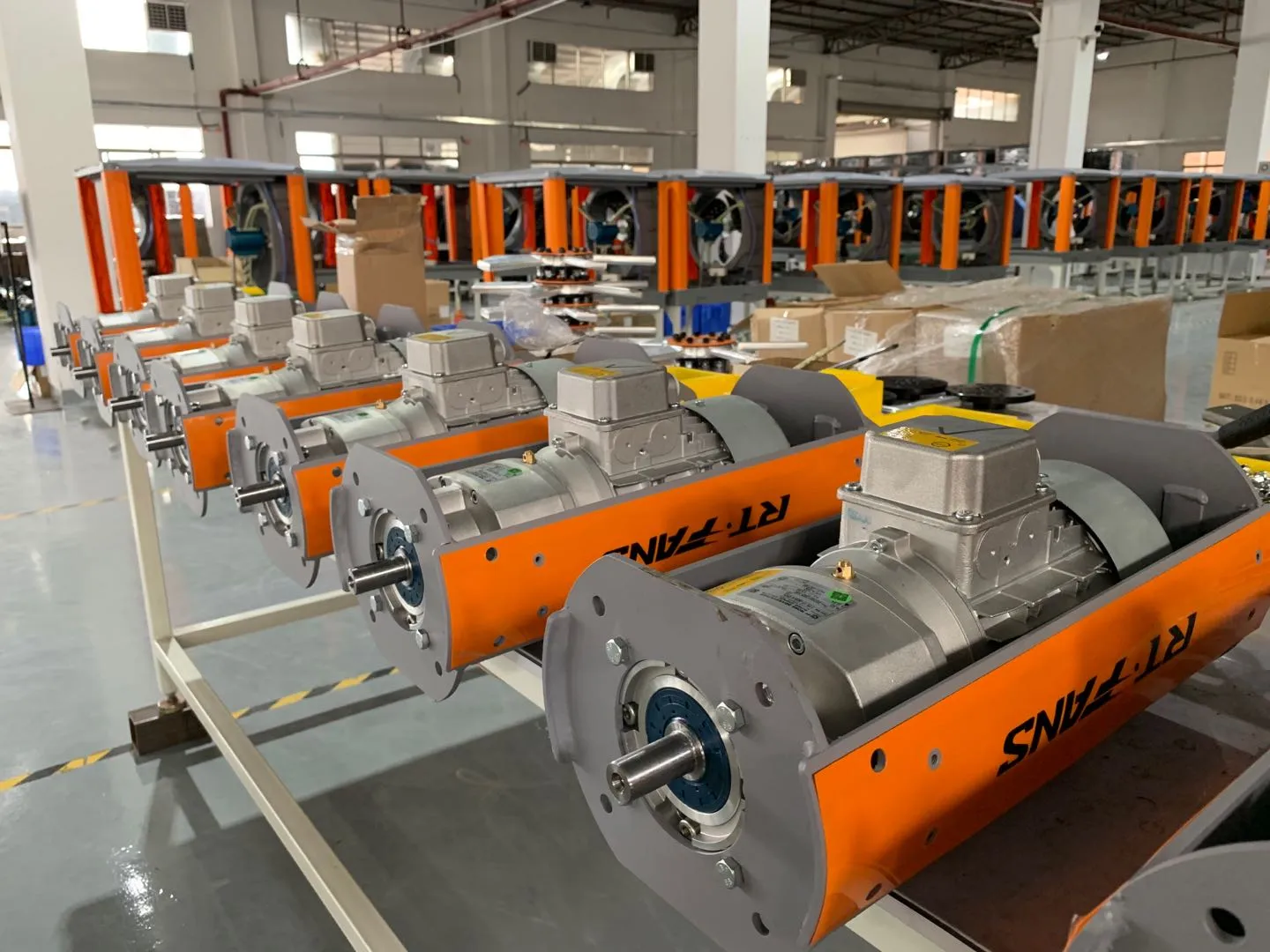
Every HVLS fan in the current RTFANS range is built around one of two motor architectures. One is a gear drive, in which a NORD geared motor reduces motor speed through a gearbox. The other is a PMSM direct drive, in which a permanent-magnet synchronous motor turns the hub without a gearbox. This guide explains how each works, which series uses which, and what an engineer should confirm before specifying either — and the HVLS fan calculator can organise your building inputs alongside.
How does a gear drive HVLS fan motor work?
An HVLS blade set turns slowly — the King series, for example, is rated at 20–53 RPM — so a gear-drive fan interposes a gearbox between motor and hub. A conventional electric motor does not naturally run at that speed: the motor runs faster, and the gearing delivers the low output speed and the torque (turning force) the blade set needs at the hub. In this range the gear drives are NORD units, supplied and assembled as part of a matched drive package with the motor, controller and hub for a specific fan size and voltage configuration.
Three RTFANS series use gear drive:
- King RTF-CF-7EEX — NORD gear motor, 1.5 kW, 220/380 V, 7.3 m, six blades, 43 dBA, 135 kg.
- Paragon RTF-FF-7EEX — NORD S3 gear drive, 1.1 kW, 7.3 m, five blades, 42 dBA, 115 kg.
- Virtue RTF-SF-5EEX — NORD S1 gear drive, 0.55 kW, 4.7 m, five blades, 40 dBA, 55 kg.
How does a PMSM direct drive HVLS fan motor work?
A PMSM (permanent-magnet synchronous motor) drive is designed to produce the fan’s operating speed directly, so the drive path from motor to hub contains no gearbox and no gear-meshing stage. The motor itself is the low-speed device, and speed is governed electronically through the controller, which is an integral part of the drive package rather than an accessory.
Two RTFANS series use PMSM direct drive:
- Charm RTF-DF-7E-1EX — PMSM, 1.5 kW, 7.3 m, six blades, 39 dBA, 120 kg.
- Grace RTF-YF-4EEX — PMSM, 0.55 kW, 4.0 m, five blades, 38 dBA, 38 kg.
What does the motor type change, and what does it not change?
The drive type changes the mechanical path, the service profile and, model by model, the published ratings. It does not by itself determine airflow: the 7.3 m gear-drive King and the 7.3 m PMSM Charm are both rated at 15,500 m³/min, while the 7.3 m gear-drive Paragon is rated at 13,800 m³/min. Airflow, noise and weight are properties of a complete model — motor, blades and diameter together — which is why the PMSM vs geared comparison works strictly from per-model published data.
What should I check when I spec an HVLS fan drive?
Confirm the same five points for whichever drive you specify, always against the documentation of the exact model rather than the drive label.
- Electrical supply. Confirm the model’s rated voltage and input power against the site supply before anything else; the King, for example, is rated for 220/380 V. Running energy follows from rated power alone: input watts × operating hours ÷ 1000 = kWh per day.
- Service planning. A gear drive puts a gearbox in the maintenance schedule. A PMSM drive removes the gearbox but makes the motor-controller package the critical service item. In both cases, ask what the manufacturer specifies for that model and how spare drive units are supplied.
- Noise sensitivity. Use the published rating of the exact model, not the drive label; in this range the ratings run from 43 dBA (King) down to 38 dBA (Grace).
- Structure and weight. Drive choice affects unit weight at a given size — at 7.3 m the gear-drive King is 135 kg and the PMSM Charm 120 kg — and the mounting point must be confirmed by a structural review in either case.
- Controller integration. Whichever drive is selected, confirm how speed is set and held, how start-up is governed, and how faults are indicated, from the model’s own documentation.
What do buyers ask most about HVLS fan motor types?
Which motor type lasts longer?
This page does not rank them, because service life depends on duty cycle (how hard and how long the fan runs), environment and whether the specified maintenance is actually done. Both architectures are in long production use in this range, so the practical question is which service profile your facility can support.
Can a gear-drive fan and a PMSM fan be used in one building?
They can, where different zones genuinely call for different models, but each fan must be specified, mounted and serviced as its own model, and a layout review is the right place to decide this — see model selection.
Where can I check the full spec of a motor?
Full product specifications for every series are published on koolairint.com, while this site works with the headline verified ratings only.
Discuss a Drive Specification
If a project specification names a motor type — or deliberately leaves it open — send the building and duty details through the layout request page. The engineering team will review the drive choice against the space, and the HVLS technology center gives the wider context on blades and control.